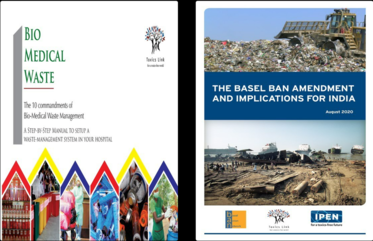

Title: An Insight of Mercury-Free Products in India
Publication Type: Research Reports
Year of Publication: 2021
Abstract:This study is an indication on the overall status of the mercury-free alternative products in India. It was found that in some of the sectors like health care and lamps, India has made considerable progress in shifting to the alternative products. However, the cost and quality of the products are the major concerns for India considering the wide diversity of the socio-economic class of people living in the country. Further information on the health hazards of mercury is low among the consumers, traders, manufacturers and the workers as well.Another important aspect of the study is that the domestic demand for mercury and mercury-free products are largely met with the import from China. Incidentally the study also reflected that with the ban on export of mercury products from China, business is getting affected particularly of health care instruments like thermometer and sphygmomanometer. Nevertheless, there are industries which are manufacturing mercury-free products in India and with suitable policy and government handholding India can become a manufacturing hub for the mercury-free products. Therefore, it’s the right time for the government to assess the current scenario and act accordingly to make it a mercury-free country and also emerge as a manufacturing hub for mercury-free products.
Suggested Readings
Common Effluent Treatment Plant: A Solution or a Problem in Itself
The Common Effluent Treatment Plan (CETP) was introduced to deal with the effluent in the SSI sector, in the hope that not only would it help in pollution abatement but would also be a step towards a cleaner environment. This-much hyped “solution” has failed because of the heterogeneous nature of the effluent from different industries. It has only compounded the toxic content to larger volumes. In addition, with the changing nature of effluents, many toxic substances have found their way into the waste stream. With the growing pace of industrialisation, CETP is unable to cater to the need of the industrial clusters, which has resulted in bypassing the treatment and directly discharging the untreated effluent in water bodies. There is a need to take an integrated approach to environmental resource use and consumption. We should be careful not to create a new problem while addressing old ones or shift the problems from one sector to another.
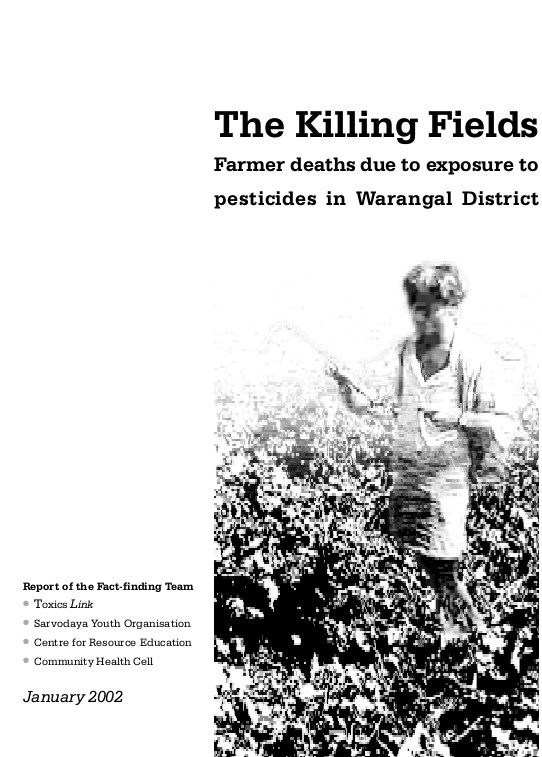
The Killing Fields: Farmer Deaths Due to Exposure to Pesticides in Warangal District
Pesticide consumption in agriculture has been on the rise in the last 20 years in India. Pesticides are used extensively in crops such as cotton, paddy, chilies, horticulture, tobacco, etc. They are also used for public health purposes like vector control for diseases like malaria, dengue, and so forth. However, little attention is given to their long term impact on the environment and human beings. The report, The Killing Fields: Farmer deaths due to exposure to pesticides in Warangal District, investigates into the harmful effects of pesticides on farmers in the Warangal district of Andhra Pradesh. The report is a collaborative effort of Toxics Link, Sarvodaya Youth Organisation, Centre for Resource Education, and Community Health Cell.
Surviving Bhopal 2002: Toxic Present – Toxic Future
Keywords: india, Delhi, NGO, Surviving, Bhopal, 2002, Toxic present, Toxic future, Environment, Toxics Link, chemical contamination, EIAs, Legislative framework, environmental hazards, TEHRI dam, hazardous wastes, municipal wastesTitle: Surviving Bhopal 2002 Toxic...